C Programming Absolute Beginnerã¢â‚¬â„¢s Guide Third Edition Review
In this article, we highlight the best books for learning Python through a collection of volume reviews. Each review gives you a taste of the volume, the topics covered, and the context used to illustrate those topics. Different books will resonate with unlike people, depending on the style and presentation of the books, the readers' backgrounds, as well as other factors.
Python is an amazing programming linguistic communication. It can be practical to most any programming task, allows for rapid development and debugging, and brings the support of what is arguably the most welcoming user community.
Getting started with Python is similar learning whatever new skill: it's important to find a resources you connect with to guide your learning. Luckily, there's no shortage of fantabulous books that can help you lot learn both the basic concepts of programming and the specifics of programming in Python. With the abundance of resources, it can exist difficult to place which volume would be best for your situation.
If you are new to Python, any of the introductory books will give you a solid foundation in the nuts.
Perchance you want to learn Python with your kid, or maybe teach Python to a group of kids. Bank check out the All-time Python Books for Kids for resources aimed at a younger audience.
Equally y'all progress in yous Python journey, you will want to dig deeper to maximize the efficiency of your code. The best intermediate and advanced Python books provide insight to help you level up your Python skills, enabling you to become an skillful Pythonista.
Afterwards reading these reviews, if you lot all the same are not certain which book to choose, publishers often provide a sample chapter or section to give y'all an case of what the book offers. Reading a sample of the book should give y'all the most representative pic of the author's pace, style, and expectations.
Regardless of which book most stands out, consider this anecdote from one of our book reviewers, Steven C. Howell:
"A favorite professor once told me, 'Information technology doesn't matter which volume you read first. Information technology'southward e'er the second one that makes the most sense.'
I tin can't say this has ever been the example for me, but I've definitely institute that a 2nd reference can make all the divergence when the first left me puzzled or frustrated.
When learning Python classes, I had difficulty relating to the examples used in the first ii books I picked upward. It wasn't until the third book I referred to that the concepts started to click.
The important lesson is that if y'all get stuck or frustrated, and the resource you accept are not helping, and so don't give up. Await at another book, search the web, ask on a forum, or just have a interruption."
Best Books for Learning Python
If you are new to Python, yous are probable in one of the following ii situations:
- Yous are new to programming and want to start past learning Python.
- You lot have a reasonable amount of programming experience in another language and now want to learn Python.
This department focuses on the first of these ii scenarios, with reviews of the books we consider to be the best Python programming books for readers who are new to both programming and Python. Accordingly, these books require no previous programming experience. They start from the absolute basics and teach both general programming concepts as well as how they apply to Python.
Python Crash Course
Eric Matthes (No Starch Press, 2016)
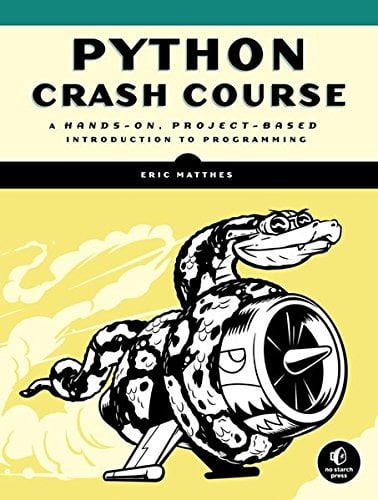
Information technology does what it says on the can, and information technology does it actually well. The volume starts out with a walkthrough of the basic Python elements and data structures, working through variables, strings, numbers, lists, and tuples, outlining how you work with each of them.
Next, if statements and logical tests are covered, followed by a dive into dictionaries.
Afterward that, the book covers user input, while loops, functions, classes, and file treatment, too as code testing and debugging.
That's just the first half of the book! In the second half, you piece of work on three major projects, creating some clever, fun applications.
The start project is an Alien Invasion game, substantially Space Invaders, adult using the pygame package. You design a transport (using classes), and so program how to airplane pilot it and make it fire bullets. Then, you design several classes of aliens, make the conflicting armada move, and make it possible to shoot them down. Finally, y'all add a scoreboard and a list of loftier scores to complete the game.
After that, the next project covers data visualization with matplotlib, random walks, rolling dice, and a fiddling bit of statistical analysis, creating graphs and charts with the pygal package. You acquire how to download data in a variety of formats, import information technology into Python, and visualize the results, likewise as how to interact with web APIs, retrieving and visualizing data from GitHub and HackerNews.
The tertiary project walks you lot through the cosmos of a complete spider web application using Django to ready a Learning Log to runway what users have been studying. It covers how to install Django, set up a project, design your models, create an admin interface, gear up user accounts, manage access controls on a per-user footing, style your entire app with Bootstrap, and then finally deploy it to Heroku.
This book is well written and nicely organized. It presents a big number of useful exercises likewise as three challenging and entertaining projects that make upward the second one-half of the volume. (Reviewed by David Schlesinger.)
- View On Amazon »
- View On Publisher Website »
Head-First Python, 2nd edition
Paul Barry (O'Reilly, 2016)
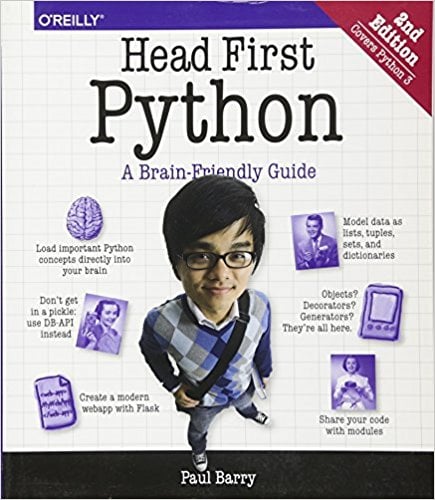
I actually similar the Head-Outset series of books, although they're admittedly lighter weight in overall content than many of the other recommendations in this department. The merchandise-off is the that this approach makes the book more convenient.
If you're the kind of person who likes to larn things one minor, adequately self-contained chunk at a time, and you desire to have lots of concrete examples and illustrations of the concepts involved, and so the Head-Kickoff serial is for y'all. The publisher'due south website has the following to say about their approach:
"Based on the latest research in cognitive science and learning theory, Head-Commencement Python uses a visually rich format to appoint your listen, rather than a text-heavy approach that puts y'all to sleep. Why waste material your time struggling with new concepts? This multi-sensory learning experience is designed for the mode your brain actually works." (Source)
Chock total of illustrations, examples, asides, and other tidbits, Head-First Python is consistently engaging and easy to read. This book starts its tour of Python by diving into lists and explaining how to use and dispense them. It and so goes into modules, errors, and file handling. Each topic is organized around a unifying project: building a dynamic website for a school athletic coach using Python through a Common Gateway Interface (CGI).
Later on that, the book spends time pedagogy yous how to employ an Android application to interact with the website you created. Yous acquire to handle user input, wrangle data, and look into what'due south involved in deploying and scaling a Python application on the web.
While this volume isn't as comprehensive as some of the others, information technology covers a skilful range of Python tasks in a fashion that's arguably more accessible, painless, and effective. This is especially truthful if you find the subject of writing programs somewhat intimidating at beginning.
This book is designed to guide you lot through any challenge. While the content is more focused, this book has plenty of fabric to keep yous busy and learning. You volition not be bored. If yous find most programming books to exist too dry, this could be an splendid volume for you lot to get started in Python. (Reviewed by David Schlesinger and Steven C. Howell.)
- View On Amazon »
- View On Publisher Website »
Invent Your Ain Computer Games with Python, 4th edition
Al Sweigart (No Starch, 2017)

If games are your affair, or you even have a game idea of your own, this would exist the perfect book to acquire Python. In this volume, yous learn the fundamentals of programming and Python with the application exercises focused on building classic games.
Starting with an introduction to the Python shell and the REPL loop, followed by a basic "Hello, World!" script, you dive right into making a basic number-guessing game, covering random numbers, flow control, blazon conversion, and Boolean data. After that, a modest joke-telling script is written to illustrate the utilize of print statements, escape characters, and basic string operations.
The next projection is a text-based cave exploration game, Dragon'due south Realm, which introduces you to flowcharts and functions, guides you through how to define your own arguments and parameters, and explains Boolean operators, global and local scope, and the sleep() office.
Later a brief detour into how to debug your Python code, you lot next implement the game of Hangman, using ASCII artwork, while learning nearly lists, the in operator, methods, elif statements, the random module, and a handful of string methods.
You and so extend the Hangman game with new features, similar discussion lists and difficulty levels, while learning near dictionaries, cardinal-value pairs, and assignment to multiple variables.
Your next project is a Tic-Tac-Toe game, which introduces some high-level bogus intelligence concepts, shows you how to short-circuit evaluation in conditionals, and explains the None value as well as some different ways of accessing lists.
Your journey through the residue of the volume proceeds in a similar vein. You'll learn nested loops while building a Mastermind-manner number guessing game, Cartesian coordinates for a Sonar Hunt game, cryptography to write a Caesar cipher, and artificial intelligence when implementing Reversi (also known as Othello), in which the computer can play confronting itself.
After all of this, at that place's a dive into using graphics for your games with PyGame: you'll comprehend how to animate the graphics, manage standoff detection, as well equally utilise sounds, images, and sprites. To bring all these concepts together, the book guides you through making a graphical obstacle-dodging game.
This volume is well done, and the fact that each project is a self-independent unit makes it appealing and accessible. If you're someone who likes to learn by doing, then you'll enjoy this volume.
The fact that this volume introduces concepts only as needed can exist a possible disadvantage. While it'southward organized more equally a guide than a reference, the broad range of contents taught in the context of familiar games makes this one of the best books for learning Python. (Reviewed past David Schlesinger.)
- View On Amazon »
- View On Writer Website »
Call up Python: How to Call up Like a Computer Scientist, 2nd edition
Allen B. Downey (O'Reilly, 2015)
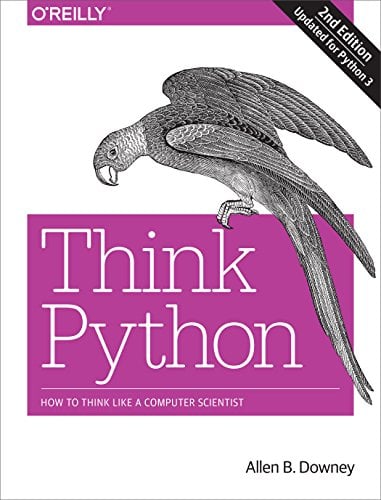
If learning Python by creating video games is too frivolous for you lot, consider Allen Downey's volume Remember Python, which takes a much more serious approach.
Every bit the title says, the goal of this book is to teach you how coders recollect nigh coding, and information technology does a good job of it. Compared to the other books, information technology's drier and organized in a more linear style. The book focuses on everything you lot need to know almost basic Python programming, in a very straightforward, articulate, and comprehensive way.
Compared to other similar books, it doesn't get quite as deep into some of the more advanced areas, instead roofing a wider range of textile, including topics the other books don't go anywhere nigh. Examples of such topics include operator overloading, polymorphism, analysis of algorithms, and mutability versus immutability.
Previous versions were a little light on exercises, but the latest edition has largely corrected this shortcoming. The book contains four reasonably deep projects, presented as instance studies, just overall, it has fewer directed awarding exercises compared to many other books.
If you like a footstep-by-step presentation of just the facts, and you want to get a little additional insight into how professional coders expect at issues, this book is a great pick. (Reviewed by David Schlesinger and Steven C. Howell.)
- View On Amazon »
- View On Publisher Website »
Constructive Computation in Physics: Field Guide to Research with Python
Anthony Scopatz, Kathryn D. Huff (O'Reilly, 2015)
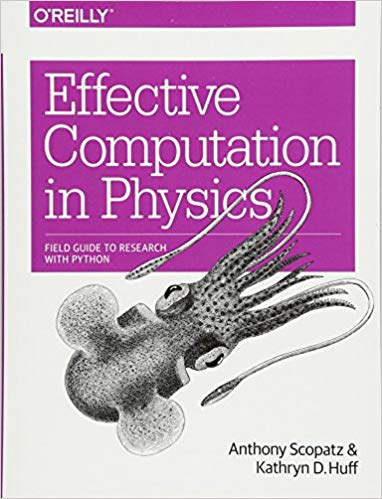
This is the book I wish I had when I was first learning Python.
Despite its proper name, this book is an excellent selection for people who don't have experience with physics, inquiry, or computational problems.
Information technology really is a field guide for using Python. On acme of actually teaching you Python, information technology also covers the related topics, like the control-line and version control, also as the testing and deploying of software.
In addition to existence a great learning resource, this volume volition also serve as an fantabulous Python reference, as the topics are well organized with plenty of interspersed examples and exercises.
The book is divided into 4 aptly named sections: Getting Started, Getting it Done, Getting it Right, and Getting information technology Out There.
The Getting Started department contains everything you need to hit the ground running. It begins with a chapter on the fundamentals of the fustigate control-line. (Aye, you tin can even install bash for Windows.) The book and so proceeds to explain the foundations of Python, striking on all the expected topics: operators, strings, variables, containers, logic, and flow command. Additionally, there is an entire chapter defended to all the dissimilar types of functions, and another for classes and object-oriented programming.
Building on this foundation, the Getting it Washed section moves into the more data-centric area of Python. Note that this section, which takes upwards approximately a third of the volume, will be most applicable to scientists, engineers, and information scientists. If that is you lot, bask. If not, feel free to skip alee, picking out any pertinent sections. Only be sure to catch the terminal chapter of the section because information technology will teach you how to deploy software using pip, conda, virtual machines, and Docker containers.
For those of yous who are interested in working with data, the section begins with a quick overview of the essential libraries for data analysis and visualization. You then have a carve up chapter dedicated to teaching yous the topics of regular expressions, NumPy, information storage (including performing out-of-core operations), specialized information structures (hash tables, data frames, D-copse, and g-d trees), and parallel computation.
The Getting it Right section teaches y'all how to avoid and overcome many of the common pitfalls associated with working in Python. It begins by extending the discussion on deploying software by education yous how to build software pipelines using brand. You then larn how to use Git and GitHub to track, store, and organize your code edits over time, a process known as version control. The section concludes by teaching you how to debug and test your code, two incredibly valuable skills.
The final section, Getting it Out At that place, focuses on effectively communicating with the consumers of your code, yourself included. Information technology covers the topics of documentation, markup languages (primarily LaTeX), code collaboration, and software licenses. The department, and book, concludes with a long list of scientific Python projects organized by topic.
This book stands out because, in addition to teaching all the fundamentals of Python, information technology also teaches yous many of the technologies used by Pythonistas. This is truly one of the best books for learning Python.
It as well serves as a cracking reference, will a full glossary, bibliography, and index. The book definitely has a scientific Python spin, but don't worry if you do not come from a scientific background. There are no mathematical equations, and you may even impress your coworkers when they see you are on reading up on Computational Physics! (Reviewed by Steven C Howell.)
- View On Amazon »
- View On Writer Website »
Learn Python 3 the Hard Way
Zed A. Shaw (Addison-Wesley, 2016)

Larn Python the Hard Mode is a classic. I'm a large fan of the book's approach. When you larn "the hard way," you lot have to:
- Blazon in all the code yourself
- Do all the exercises
- Find your ain solutions to bug yous encounter
The smashing matter near this book is how well the content is presented. Each chapter is clearly presented. The code examples are all curtailed, well constructed, and to the point. The exercises are instructive, and whatsoever problems y'all see volition not be at all insurmountable. Your biggest gamble is typographical errors. Go far through this volume, and you'll definitely no longer be a beginner at Python.
Don't permit the title put you lot off. The "hard fashion" turns out to be the easy way if you take the long view. Nobody loves typing a lot of stuff in, but that'southward what programming really involves, and then it's good to get used to it from the outset. One dainty thing nearly this volume is that information technology has been refined through several editions now, and so any crude edges have been made nice and smooth by at present.
The book is constructed as a series of over 50 exercises, each building on the previous, and each teaching you lot some new feature of the language. Starting from Exercise 0, getting Python prepare upwards on your computer, you begin writing simple programs. You learn about variables, data types, functions, logic, loops, lists, debugging, dictionaries, object-oriented programming, inheritance, and packaging. Y'all even create a simple game using a game engine.
The next sections cover concepts like automatic testing, lexical scanning on user input to parse sentences, and the lpthw.web package, to put your game up on the web.
Zed is an engaging, patient writer who doesn't gloss over the details. If y'all work through this book the right manner—the "hard way," by following up on the report suggestions provided throughout the text as well as the programming exercises—you'll be well across the beginner programmer stage when you lot've finished. (Reviewed past David Schlesinger.)
- View On Amazon »
- View On Author Website »
Real Python Class, Part 1
Real Python Team (Real Python, 2017)
This eBook is the first of three (so far) in the Real Python course series. It was written with the goal of getting you upwards and running, and it does a great job at achieving this goal. The book is a mix of explanatory prose, instance code, and review exercises. The interspersed review exercises solidify your learning past letting you immediately employ what you've learned.
As with the previous books, clear instructions are provided up front for getting Python installed and running on your reckoner. After the setup department, rather than giving a dry overview of information types, Existent Python but starts with strings and is really quite thorough: you learn string slicing before you hitting folio 30.
Then the book gives you a good sense of the flavor of Python by showing you how to play with some of the course methods that can be applied. Adjacent, yous learn to write functions and loops, use conditional logic, work with lists and dictionaries, and read and write files.
Then things get really fun! Once you've learned to install packages with pip (and from source), Real Python covers interacting with and manipulating PDF files, using SQL from within Python, scraping information from web pages, using numpy and matplotlib to do scientific computing, and finally, creating graphical user interfaces with EasyGUI and tkinter.
What I like best about Real Python is that, in addition to covering the basics in a thorough and friendly style, the volume explores some more advanced uses of Python that none of the other books striking on, similar web-scraping. In that location are also two additional volumes, which go into more advanced Python evolution. (Reviewed by David Schlesinger.)
- View On Real Python »
Best Python Books for Kids
The following books are aimed at adults interested in pedagogy kids to code, while possibly learning information technology themselves along the way. Both of these books are recommended for kids as immature as 9 or x, simply they are corking for older kids besides.
Information technology'south important to note that these books are not meant to be just handed to a child, depending on their age. They would be ideal for a parent who wanted to learn Python alongside their child.
Python for Kids: A Playful Introduction to Programming
Jason R. Briggs (No Starch, 2013)

"Playful" is right! This is a fun book for all ages, despite its title. It provides a clear, like shooting fish in a barrel to follow, introduction to Python programming. It's profusely illustrated, the examples are straightforward and conspicuously presented, and it'southward a solid guide for someone who wants to get a good grounding in the basics, plus a footling more.
The book begins with an excellent, detailed guide to getting Python installed on your system, whether that'southward Windows, Bone X, or Ubuntu Linux. Information technology then gain to introduce the Python shell and how it tin be used as a elementary calculator. This serves to introduce some basic concepts similar variables and arithmetic operation.
Next, iterables are tackled, and the chapter works its fashion progressively through strings, lists, tuples, and dictionaries.
Once that'south accomplished, the Python turtle library is used to brainstorm working with turtle graphics, a pop framework for teaching children to code. From in that location, the book progresses through conditional statements, loops, functions, and modules.
Classes and objects are covered, followed past a truly excellent section on Python's built-in functions, and then a section on a number of useful Python libraries and modules. Turtle graphics are revisited in greater detail, later which the book introduces tkinter for creating user interfaces, better graphics, and even animations.
This concludes part ane of the book, "Learning to Plan," with the remainder focused on edifice two fun application projects. The first project is to build a single-player version of Pong, called Bounce! This integrates the programming concepts of functions, classes, and command period, together with the tasks of creating an interface using tkinter, illustrating to the canvas, performing geometric calculations, and using event bindings to create interactivity.
In the second project, you build a side-scrolling video game, Mr. Stickman Races for the Exit. This game applies many of the same concepts and tasks as Bounce! just with more than depth and increased complexity. Along the mode, yous also become introduced to the open source image manipulation plan GIMP, used to create your game's avails. The book gets an amazing amount of mileage out of these two games, and getting them working is both instructive and a lot of fun.
I actually like this book. Whether y'all are young, or just young at middle, y'all volition savor this book if y'all are looking for a fun, approachable, introduction to Python and programming. (Reviewed by David Schlesinger and Steven C. Howell.)
- View On Amazon »
- View On Publisher Website »
Teach Your Kids to Code: A Parent-Friendly Guide to Python Programming
Bryson Payne (No Starch, 2015)
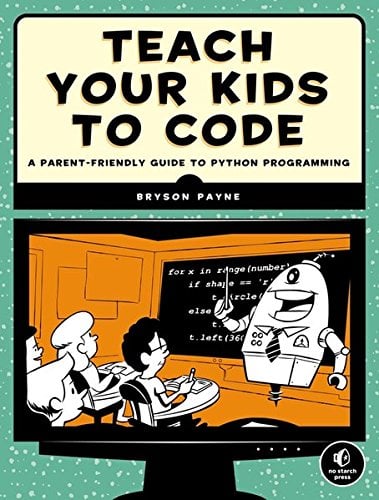
This book is similar to Python for Kids but intended more for an adult working with a child (or children) to learn to lawmaking, as the championship suggests. I thing that sets this book apart from most introductory books is the use of color and illustrations on almost every page. The volume is well written and presents learning to code as a way to teach children problem-solving skills.
As is commonly the case, this book begins with a Python installation guide. Compared to Python for Kids, the guide in this book is more brief just completely adequate.
The outset action is, over again, turtle graphics. A number of bones variations on drawing a rotated square are presented—without a lot of underlying explanation, initially—just to introduce the general concepts, simply by the end of the section, you'll have been provided with a pretty skilful understanding of the nuts.
Next, calculations, variables, and mathematics in Python are explained. Once strings have been covered, the book brings all of that back into turtle graphics to enhance and explore the work that was done earlier. By this point, the code explanations are extremely clear, with explicit line-by-line details. Yous'd have a hard time misunderstanding whatever of the code presented.
Lists are explored adjacent, as is the eval() office. Loops are introduced and and so used to create increasingly circuitous graphics with the turtle. Conditional expressions come next, along with Boolean logic and operators.
The random library is introduced with a guessing game and randomly placed spirals made with turtle graphics. Y'all explore randomness further by implementing rolling dice and picking cards, which leads up to you creating the games Yahtzee and War.
Functions, more than advanced graphics, and user interaction are investigated next.
The volume then branches off to cover using PyGame to create even more than advanced graphics and animations, and then user interaction to create a very simple cartoon program.
At this bespeak, you have all the tools to create some real games. Evolution of both a full-featured version of Pong and a bubble-popping game are presented. Both provide plenty depth to pose some challenges and maintain interest.
What I like best most this book is its big number of programming challenges, every bit well as the fantabulous summaries at the stop of each chapter reminding you what was covered. If y'all and your child are interested in programming, this book should take both of yous a good distance, and yous'll take a lot of fun. As the writer, Dr. Bryson Payne, said in his recent TEDx talk, "Step out of your condolement zone, and become literate in the language of applied science." (Reviewed past David Schlesinger and Steven C. Howell.)
- View On Amazon »
- View On Publisher Website »
Best Intermediate and Avant-garde Python Books
Knowing Python is 1 affair. Knowing what's Pythonic takes exercise. Sometimes Python's low barrier to entry gives people the mistaken idea that the language is less capable than other languages, that style does not matter, or that best practices are only a matter of preference. Have you ever seen Python lawmaking that looked like C or Fortran?
Learning how to use Python effectively requires some agreement of what Python is doing under the hood. Pythonic programming takes advantage of how the Python language is implemented to maximize the efficiency of your lawmaking.
Fortunately, there are some excellent books, packed with expert guidance, aimed to help you accept what you've learned and level upwardly your skills. Whatever of the books in this section will give you a deeper agreement of Python programming concepts and teach y'all how to write programmer-style Python code. Note that these are by no means introductory books. They practice not include the basics of getting started. These books volition be helpful if you are already coding in Python and want to further hone your skills on your path to condign a serious Pythonista.
Python Tricks: A Buffet of Awesome Python Features
Dan Bader (dbader.org, 2017)
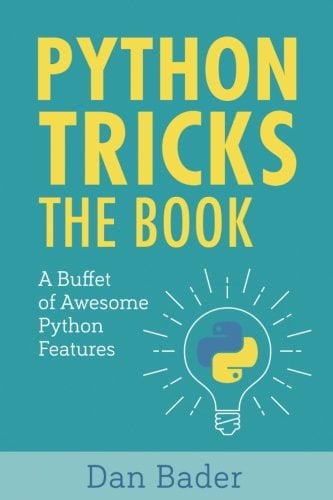
This book illustrates valuable lesser-known Python features and best practices, written to help you lot gain a deeper understanding of Python. Each of the 43 subsections presents a different concept, referred to as a Python Flim-flam, with discussion and easy-to-digest code examples illustrating how you can take advantage of that concept.
The book'southward content is cleaved into the following sections:
- Patterns for Cleaner Python
- Constructive Functions
- Classes & OOP
- Common Data Structures in Python
- Looping & Iteration
- Lexicon Tricks
- Pythonic Productivity Techniques
Equally information technology says on the cover, the content is organized every bit "A Buffet," with each subsection beingness a cocky-contained topic, with a brief introduction, examples, discussion, and list of Key Takeaways. Every bit such, you lot should experience free to jump around to whichever sections are the virtually highly-seasoned.
In add-on to the book, I especially enjoyed the 12 Bonus Videos that are available when yous purchase this as an eBook. They accept an average length of 11 minutes, perfect for watching during lunch. Each video illustrates a different concept using clear and concise code examples that are simple to reproduce. While some of the videos covered familiar concepts, they still provided interesting insight without dragging on. (Reviewed past Steven C. Howell.)
- View On Amazon »
- View On Existent Python »
Fluent Python: Clear, Concise, and Effective Programming
Luciano Ramalho (O'Reilly, 2014)
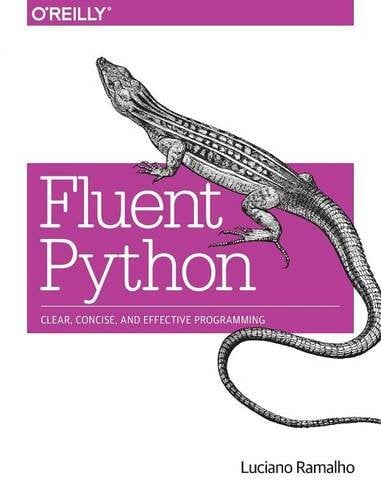
This volume was written for experienced Python ii programmers who want to get adept in Python 3. Consequently, this book is perfect for someone with a solid foundation in the basics of Python, 2 or iii, who wants to take their skills to the side by side level. Additionally, this book also works well as a reference for an experienced programmer from another language who wants to await up "How do I exercise <10> in Python?"
The book is organized by topic so that each section tin exist read independently. While many of the topics covered in this book are found in introductory books, Fluent Python provides much more detail, illuminating many of the more than nuanced and disregarded features of the Python language.
The chapters are broken into the following half dozen sections:
- Prologue: introduces Python's object-oriented nature and the special methods that keep Python libraries consistent
- Data Structures: covers sequences, mappings, sets, and the difference between
strandbytes - Functions as Objects: explains the consequences of functions being start-course objects in the Python linguistic communication
- Object-Oriented Idioms: includes references, mutability, instances, multiple inheritance, and operator overloading
- Control Flow: extends beyond the basic conditionals and covers the concept of generators, context managers, coroutines,
yield fromsyntax, and concurrency usingasyncio - Metaprogramming: explores the lesser know aspects of classes, discussing dynamic attributes and backdrop, attribute descriptors, course decorators, and metaclasses
With code examples on almost every page, and numbered call-outs linking lines of lawmaking to helpful descriptions, this book is extremely approachable. Additionally, the lawmaking examples are geared toward the interactive Python console, a practical approach to exploring and learning the concepts presented.
I find myself turning to this book when I accept a Python question and want an explanation that is more thorough than the one I would probable get on Stack Overflow. I also savour reading this volume when I accept a bit of downward-fourth dimension and merely want to learn something new. On more than one occasion, I have found that a concept I recently learned from this book unexpectedly turned out to be the perfect solution to a problem I had to solve. (Reviewed by Steven C. Howell.)
- View On Amazon »
- View On Publisher Website »
Effective Python: 59 Means to Write Meliorate Python
Brett Slatkin (Addison-Wesley, 2015)

This book is a drove of 59 independent articles that build on a basic understanding of Python to teach Pythonic best practices, lesser known functionality, and built-in tools. The topics range in complication, starting time with the simple concept of existence enlightened of which Python version you're using, and catastrophe with the more than complicated, and typically ignored, concept of identifying memory leaks.
Each article is a combination of example code, give-and-take, and a list of things to recollect.
As each article is independent, this is a great book to jump around in, allowing yous to focus on the topics that are most applicable or interesting. This also makes it perfect for reading one article at a fourth dimension. With each article being around 2 to four pages in length, y'all could brand time to read one article per day, finishing the book in two to three months (depending on whether y'all read on weekends).
The articles are grouped into the following viii capacity:
- Pythonic Thinking: introduces the best ways to perform common tasks, while taking advantage of how Python is implemented
- Functions: clarifies nuanced differences of Python functions and outlines how to apply functions to analyze intention, promote reuse, and reduce bugs
- Classes and Inheritance: outlines the best practices when working with Python classes
- Metaclasses and Attributes: illuminates the somewhat mysterious topic of metaclasses, education you how to employ them to create intuitive functionality
- Concurrency and Parallelism: explains how to know to write multi-threaded applications in Python
- Congenital-in Modules: introduces a few of Python's lesser-known congenital-in libraries to brand your code more than useful and reliable
- Collaboration: discusses proper documentation, packaging, dependency, and virtual environments
- Production: covers the topics of debugging, optimization, testing, and memory management
If you lot have a solid foundation in Python and want to make full in holes, deepen you agreement, and learn some of the less obvious features of Python, this would be a bully book for you. (Reviewed by Steven C. Howell.)
- View On Amazon »
- View On Author Website »
Python Cookbook
David Beazley & Brian K. Jones (O'Reilly, 3rd edition, 2013)
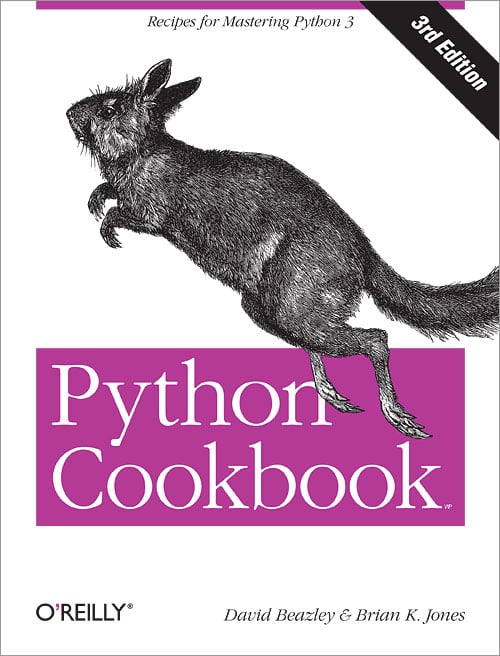
What makes this book stand out is its level of detail. Code cookbooks are typically designed as short and sugariness manuals to illustrate slick means of doing everyday tasks. In this case, each recipe in Python Cookbook has an extended code solution as well equally an author's discussion of some detail elements of the solution.
Each recipe starts out with a clear problem statement, such as, "You want to write a decorator that adds an extra argument to the calling signature of the wrapped office." It and so jumps into a solution that uses modern, idiomatic Python three code, patterns, and data structures, often spending four to five pages discussing the solution.
Based on its more than involved and sophisticated examples, and the authors' ain recommendation in the preface, this is probably the about advanced Python book on our list. Despite that, don't be scared away if you consider yourself an intermediate Python programmer. Who's judging, anyway? In that location's an old maxim that goes something similar this:
"The best way to become a better basketball game player is to lose to the best players you can detect, rather than beating the worst."
You may see some code blocks you don't fully understand—come back to them in a few months. Re-read those sections after yous've picked upwards a few boosted concepts, and suddenly, it will click. Most of the chapters start out fairly straightforward, and so gradually get more intense.
The latter one-half of the book illustrates designs like decorator patterns, closures, accessor functions, and callback functions.
It'due south always dainty to read from a trustworthy source, and this book'due south authors certainly fit that bill. David Beazley is a frequent keynote speaker at events such as PyCon and also the author of Python Essential Reference. Similarly, Brian K. Jones is a CTO, the creator of a Python magazine, and founder of the Python User Group in Princeton (PUG-IP).
This particular edition is written and tested with Python three.3. (Reviewed by Brad Solomon.)
- View On Amazon »
- View On Publisher Website »
Become Coding!
Ane of the awesome things near Python is it has a relatively depression barrier to entry, compared to many other languages. Despite this, learning Python is a never-ending process. The language is relevant for such a wide diversity of tasks, and evolves and so much that there will always be something new to detect and learn. While you can pick up enough Python to practise some fun things in a week or ii, people who've been using Python for 20 years will tell you they're withal learning new things they can practice with this flexible and evolving linguistic communication.
To ultimately be successful as a Python developer, you need to begin with a solid foundation, then gain a deeper agreement of how the language works, and how to best put it to use. To gain a solid foundation, you really can't go incorrect with any of the best books to learn Python. If you want to learn Python with a kid, or maybe teach a group of kids, check out the list of all-time Python books for kids. After y'all've got your feet wet, check out some of the best intermediate and advanced Python books to dig in deeper to less obvious concepts that will improve the efficiency of your lawmaking.
All of these books will teach y'all what you demand to know to legitimately telephone call yourself a Python coder. The only ingredient missing is y'all.
Source: https://realpython.com/best-python-books/

Post a Comment for "C Programming Absolute Beginnerã¢â‚¬â„¢s Guide Third Edition Review"